You’re Not Lazy- Your Environment Is Broken
You’ve set goals, written them down, and still nothing moves. Before you call yourself lazy, read this. The real problem might not be you — it might be where you’re trying to win.
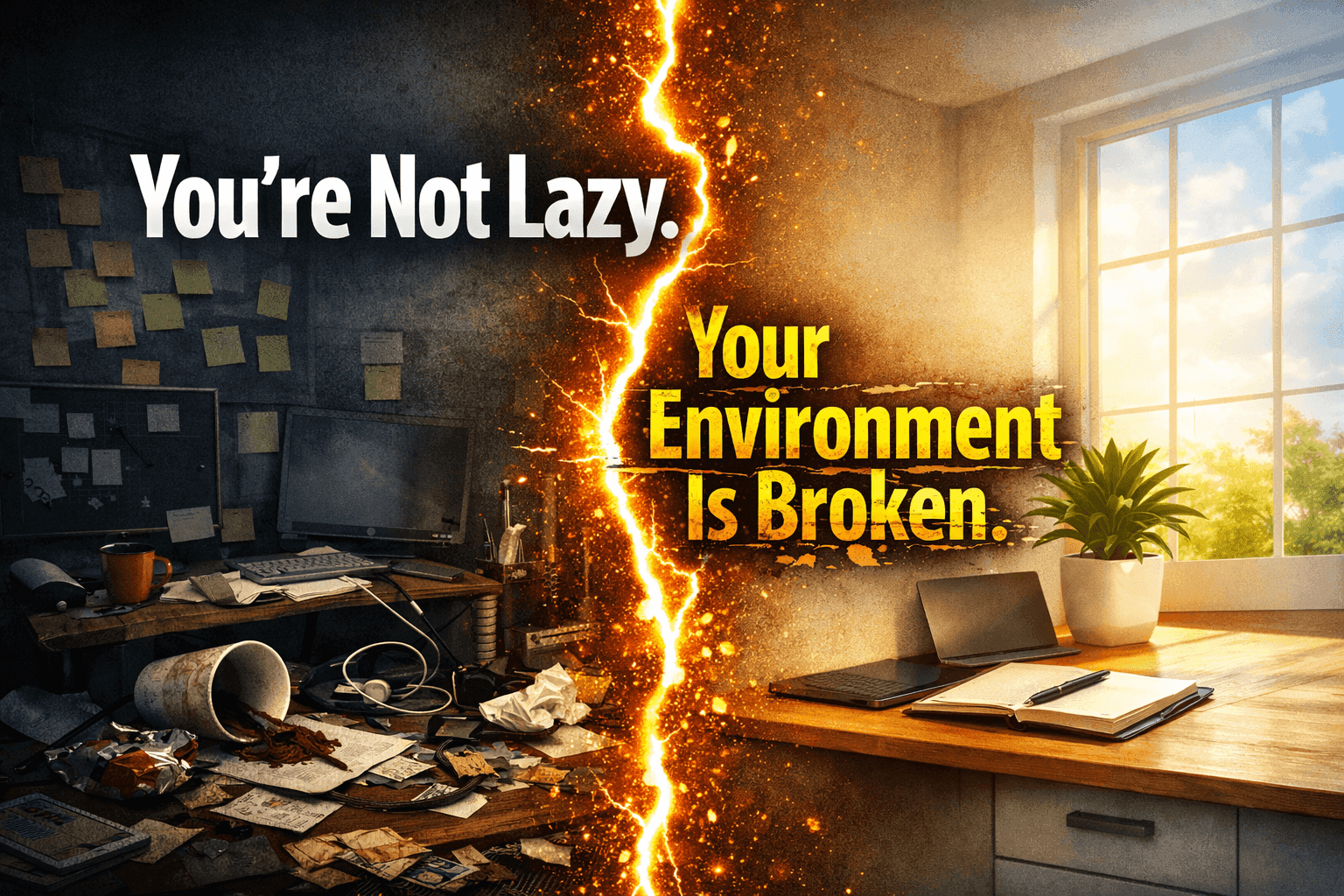
You've tried. You've made the plans. You've set the alarms. You've written the goals in the notebook. And still — nothing moves.
So you tell yourself the only explanation left: you're lazy.
But what if that's not true? What if the problem isn't who you are — but where you are?
What if your environment has been quietly working against you this whole time — and nobody told you?
Think about your day. Where do you work? Where do you rest? Where do you scroll?
If it's all the same place — your bed, your couch, the same corner of your room — then your brain has no signal for when to focus and when to quit.
You sit down to work, but your body remembers: this is where you sleep. This is where you watch videos at 2am. This is where you gave up last time.
Your phone is within arm's reach. Your snacks are nearby. Every distraction you've ever had is within three seconds of your hands.
And then you wonder why you can't focus for thirty minutes straight.
This is not a character flaw. This is physics. You are responding exactly the way a human being responds to a broken environment.
The problem was never you. The problem is the stage you've been performing on.
Point 1 — Your environment is a script
Scientists who study human behavior have found something that should change how you see yourself. Most of what we do every single day is not a decision. It's a response.
You walk into your kitchen and you eat — not because you're hungry, but because the kitchen told you to eat. You pick up your phone — not because you chose to, but because your hand has done it ten thousand times.
Your environment is a script. And right now, your script says: scroll, sleep, distract, delay.
But here's the power in that: if environment writes behavior, then changing your environment changes your behavior. You don't need more willpower. You need a better stage.
Point 2 — Remove before you add
Most people try to build discipline by adding things. A new habit. A new routine. A new app to track their productivity.
But the most powerful thing you can do is remove.
Remove your phone from your workspace. Not silent. Not face down. In another room. Because research shows that even having a phone visible on a desk — even switched off — reduces your cognitive capacity. Your brain is spending energy resisting it.
Remove the option. Don't fight the temptation. Eliminate it.
What is the one thing in your environment right now that's stealing your focus without you even realising it? Remove it before tomorrow.
Point 3 — Design friction into bad habits
There's a principle that the most productive people in the world use — they make their bad habits harder to do.
Log out of social media every single time you use it. Delete the apps and make yourself re-download them. Put your TV remote in a drawer. Sleep with your phone charger outside the bedroom.
You're not fighting your willpower. You're building a small wall between you and the thing that destroys your time.
Even ten seconds of friction is enough to stop an automatic habit cold. Because most bad habits don't survive inconvenience.
Point 4 — Create a trigger space
Your brain links places to states. A church feels quiet. A gym feels energizing. A library feels focused.
You need a space that means one thing: work. Or study. Or creation. Whatever your goal is.
It doesn't have to be a separate room. It can be one corner. One chair. One desk. But that space only exists for that one purpose. You don't eat there. You don't scroll there. You don't rest there.
Over time — and this happens faster than you think — your brain starts to shift the moment you sit in that space. The environment activates the behavior before your mind even makes a choice.
You stop fighting to start. The space starts for you.
Point 5 — The people around you are environment too
We talk about desks and phones and rooms. But the most powerful environment you have is the people you spend time with.
If everyone around you normalizes wasting time, staying small, laughing at ambition — then ambition feels wrong inside you. Not because it is wrong. Because your environment is telling you it is.
You don't have to leave everyone behind. But you need at least one person — online, in person, a voice in a podcast — who makes progress feel normal. Who makes building something feel possible.
Protect that input like your life depends on it. Because in a very real sense, your future does.
Today — not next week, not when things are better — today, I want you to do one thing.
Look around wherever you are right now. Find one thing in your environment that is actively working against the person you're trying to become. One thing.
And change it.
Move your phone. Rearrange your desk. Delete an app. Tell one person about something you're building.
One change. Today.
Because the person you want to be is not waiting on motivation. They're waiting on the right conditions. And you are the one who builds those conditions.
You were never broken. Your environment was. And now — you know what to do about it.
Stay sharp on Nigeria
Get the best stories on money, tech, and culture delivered weekly. No spam, unsubscribe anytime.
The Writer
zion oye contributes deep insights into the evolution of Nigeria's digital and cultural landscape.