How developers use AI tools to build apps quickly
From intelligent code completion to automated testing and one-click deployment — AI is collapsing the distance between idea and shipped product.
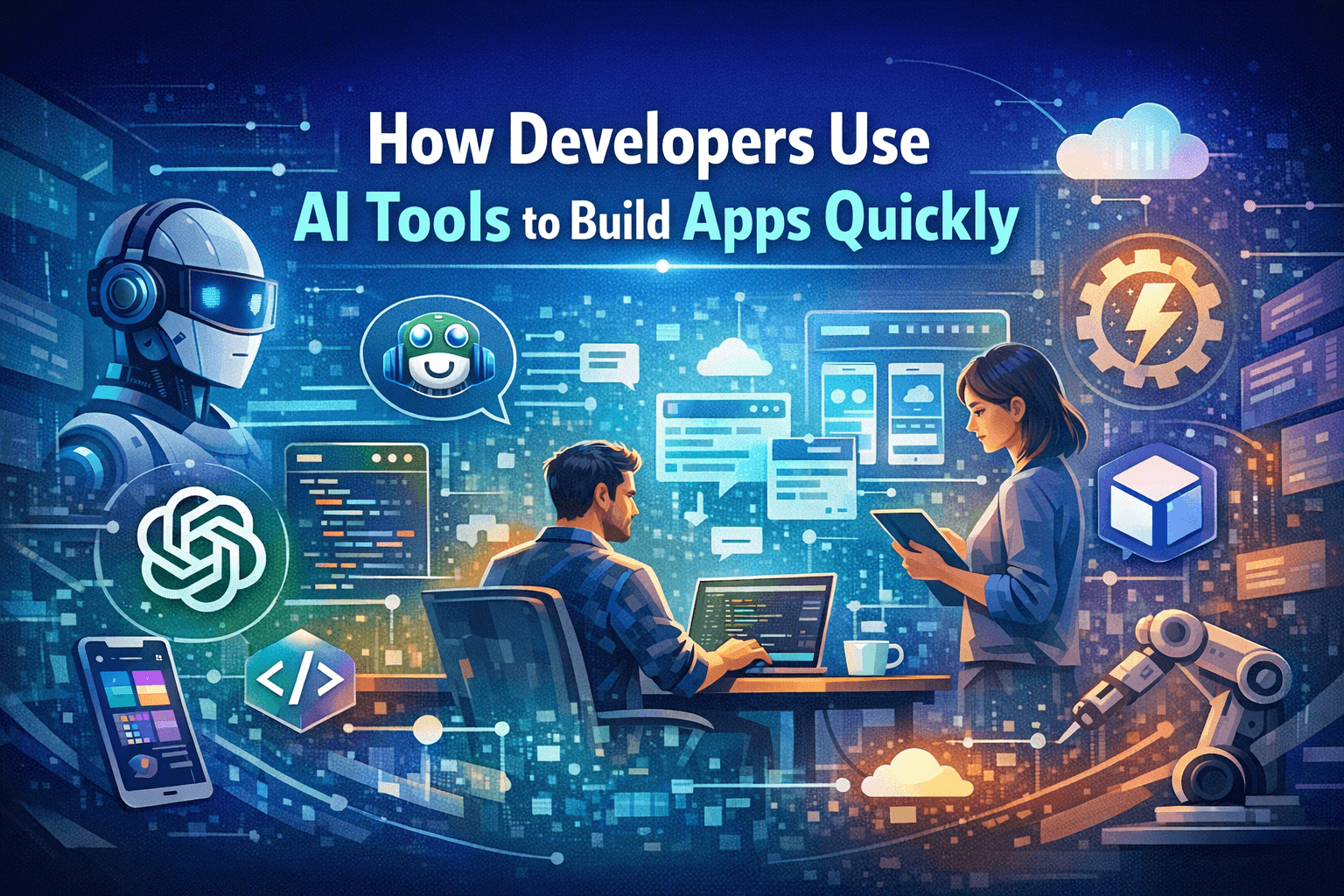
Speed Is the New Competitive Moat
In the current technology landscape, the gap between a brilliant product idea and a live, revenue-generating application has never been narrower — or more fiercely contested. Startups can go from wireframe to App Store in weeks. Enterprise teams ship features in days that used to take quarters. What changed? The answer, increasingly, is artificial intelligence woven directly into the development workflow.
Speed is no longer just a nice-to-have. Investors expect it. Users demand it. Competitors weaponize it. A developer who can prototype, iterate, and deploy twice as fast as their peers holds a structural advantage that compounds over time. This is the promise — and the increasingly practical reality — of AI app development tools.
This guide is your comprehensive map to that world. Whether you're a solo developer building your first SaaS product, a mobile engineer at a growth-stage startup, or a tech leader charting your team's toolchain for the next three years, you'll find actionable insight on every aspect of the AI-accelerated development lifecycle — from the first keystroke to production deployment.
The developers who will define the next decade aren't the ones who write the most code. They're the ones who direct the most intelligent machines.
The Evolution of AI in Software Development
To understand where we are, it helps to trace how quickly we got here.
From Autocomplete to Co-Pilot (2018–2022)
The earliest AI coding tools were glorified autocomplete engines — statistically predicting the next token in a line of code, much like a smartphone keyboard predicts the next word. Useful? Yes, modestly so. Transformative? Not quite. But they seeded developer appetite for something bigger.
The inflection point came with large language models. When OpenAI's Codex — the model underlying GitHub Copilot — demonstrated the ability to generate entire functions from natural-language comments, the industry's imagination caught fire. Suddenly "autocomplete" felt like an understatement.
The Generative Era (2023–Present)
By 2023, AI coding assistants had become mainstream. GitHub reported that Copilot users were accepting AI-suggested code for roughly 30–40% of their keystrokes. Tabnine, Amazon CodeWhisperer, and a wave of challengers had entered the market. Meanwhile, ChatGPT and Claude became informal pair programmers for millions of developers, consulted for everything from architecture decisions to regex puzzles.
Today, the conversation has shifted from "should we use AI tools?" to "which combination of AI tools optimizes our specific stack and velocity?" AI is no longer an experiment — it is infrastructure.
AI-Powered Coding: Writing Less, Shipping More
The most visible application of AI in app development is, unsurprisingly, writing code. But the depth and sophistication of that assistance has grown far beyond autocomplete.
Intelligent Code Generation and Completion
Modern AI coding assistants operate at multiple levels simultaneously. They understand the file you're editing, the broader codebase context, the language idioms, your team's style conventions, and even the documentation of external libraries. The result is suggestions that feel eerily prescient — not just the next line, but the next logical block.
GitHub Copilot — The category leader. Integrates into VS Code, JetBrains, and Neovim. Excels at boilerplate elimination and test generation.
Tabnine — Strong enterprise adoption, with privacy-first options and local model deployment. Particularly effective at learning team-specific patterns.
Amazon Q Developer — Tightly integrated with AWS services, making it invaluable for cloud-native teams building on Lambda, DynamoDB, or ECS.
Cursor — An AI-native code editor that treats the entire codebase as conversational context, enabling multi-file refactors through chat.
Natural Language to Working Code
Beyond completion, developers now routinely describe functionality in plain English and receive working implementations. "Write a React component that fetches paginated data from this endpoint, handles loading and error states, and uses Tailwind for styling" is a valid prompt that yields production-ready code in seconds. This is rapid app prototyping with AI at its most immediate — collapsing hours of boilerplate work into a few exchanges.
AI-Assisted Debugging: From Guesswork to Guided Diagnosis
Debugging has historically been equal parts art and frustration. AI tools are shifting that balance decisively.
Contextual Error Explanation
When a stack trace appears, modern AI assistants don't just identify the error type — they explain the chain of causation, highlight likely root causes, and propose concrete fixes, all within the context of your specific codebase. What used to require a senior engineer's intuition is increasingly available on demand.
Proactive Code Review
Tools like CodeRabbit and SonarQube's AI layer review pull requests automatically, flagging not just syntax errors but logical issues, security vulnerabilities, and performance anti-patterns. Teams using AI-assisted code review report finding more bugs before production, without adding reviewer burden — a rare productivity double win.
AI in UI/UX Design: From Blank Canvas to Working Interface
Design has traditionally been one of the longest bottlenecks in early-stage app development. AI tools are dismantling that bottleneck from both ends.
Design-to-Code Pipelines
Tools like Anima, Locofy, and Figma's own AI features can convert high-fidelity design mockups into responsive, component-based code — React, Vue, or Flutter — with impressive fidelity. What once required a dedicated front-end engineer to hand-translate Figma files now often takes an afternoon of AI-assisted conversion and cleanup, freeing engineers to focus on logic rather than layout transcription.
Generative UI Scaffolding
v0 by Vercel allows developers to describe an interface in natural language and receive a working, styled component. "A dashboard with a sidebar nav, a KPI card row at the top, and a data table below with search and filter functionality" generates production-quality Tailwind and React code in under a minute. For teams doing rapid app prototyping with AI, this capability has effectively eliminated the blank-canvas problem — you always have something real to react to, iterate on, and show stakeholders.
AI-Driven Testing: Quality at Machine Speed
Testing is the task most developers acknowledge as critical and most reliably deprioritize under time pressure. AI changes the calculus by dramatically reducing the cost of thorough test coverage.
Automated Test Generation
Given a function, a class, or an API endpoint, AI tools can generate comprehensive unit test suites — including edge cases that human developers routinely miss. GitHub Copilot, Codium AI, and Diffblue Cover all offer this capability. Developers who once dreaded test writing now delegate the first draft to their AI assistant, reserving their attention for reviewing and enriching the output rather than staring at a blank test file.
End-to-End and Regression Testing
AI-enhanced tools like Playwright with Copilot integration can generate end-to-end test scripts from natural language scenarios. "Test that a user can sign up, verify their email, log in, and complete their profile" becomes an executable test suite, not a manual QA checklist. This is particularly valuable in AI in mobile app development workflows, where cross-device and cross-OS testing complexity would otherwise be exponential.
AI and Deployment: Smarter Pipelines, Faster Releases
Deployment and infrastructure, once the specialized domain of DevOps engineers, are increasingly accessible to full-stack developers through AI-assisted tooling.
Infrastructure as Conversation
Platforms like Pulumi AI and AWS's generative AI features allow developers to describe infrastructure requirements in natural language and receive deployable Infrastructure as Code configurations. "Set up a scalable Node.js API with auto-scaling, a Redis cache, and a PostgreSQL database on AWS" produces working Terraform or CloudFormation — accelerating even experienced DevOps engineers by an order of magnitude and making cloud deployment accessible to developers who previously found IaC impenetrable.
Intelligent CI/CD Optimization
AI-powered CI/CD systems can analyze test failure patterns, predict flaky tests, prioritize test execution based on code change impact, and automatically suggest pipeline optimizations. Teams using these tools report meaningful reductions in both build times and post-deployment incidents — two metrics that directly affect developer experience and customer satisfaction.
The Competitive Advantage Is Available Right Now
The developers and teams who treat AI as a core capability — not an optional add-on, not a toy to experiment with in spare hours — will ship faster, scale leaner, and build better than those who don't. That gap will widen, not narrow, as the tooling matures and the productivity differential compounds.
The tooling is mature. The ROI is proven. The learning curve is gentler than you think. The most important step is simply starting: pick one tool, integrate it into your real workflow, and pay attention to what changes. Most developers who do report they cannot imagine returning to working without it.
For tech leaders, the strategic implication is equally clear. AI-assisted development is not a cost center or an experiment to be budgeted cautiously — it is competitive infrastructure. Teams that build AI into their development culture now will have built-in institutional advantages that are very difficult to replicate in 18 months. The time to build that advantage is not next quarter.
It is now.
Stay sharp on Nigeria
Get the best stories on money, tech, and culture delivered weekly. No spam, unsubscribe anytime.
The Writer
ola dipps contributes deep insights into the evolution of Nigeria's digital and cultural landscape.